
 About
About Deals
Deals Articles
 Genres

Author, essayist, and professor Annie Dillard, who broke onto the literary scene with her 1974 masterpiece Pilgrim at Tinker Creek, died Tuesday at her home in South Wellfleet, Mass. Her literary executor, Maggie Nelson, confirmed her death. She was 81.
Chronicling a year of spiritual and physical observations of the natural world around her home in Virginia’s Roanoke Valley, the book won the Pulitzer Prize for General Nonfiction in 1975. Critics quickly praised Dillard’s work as the 20th-century counterpart to Walden—a meditation on self-reliance and simple living inspired by the two years author Henry David Thoreau spent living alone in a cabin.
In her 1987 autobiography, An American Childhood, Dillard recalls growing up as a serious reader who roamed freely. She went to college at the recommendation of her high school principal, who thought it would tone down her rough ways—she’d been suspended from school for smoking. She’d eventually earn her bachelor’s and master’s degrees from Hollins College in 1967 and ’68, studying English, theology, and creative writing.
Her first book, which was released only a few months before Pilgrim at Tinker Creek, was a collection of poems: Tickets for a Prayer Wheel. She’d go on to publish 13 books in total, spanning narrative nonfiction, essays, novels, poetry, and memoir. Her other best-known work is The Maytrees (2007), her last published novel. Beginning in 1980, Dillard taught for 21 years in Wesleyan University’s English department.
In her later years, Dillard largely stepped back from her public literary life. Writing less and no longer traveling, she shared on her public website, “I’ve got to read and concentrate.” Dillard’s last public outing was in 2014, when President Barack Obama awarded her the National Humanities Medal for her “profound reflections on human life and nature.”
Her work—which continues to be widely taught in schools—will be long remembered for its philosophical inquiry and its reminder of our need to foster a relationship with the natural world.
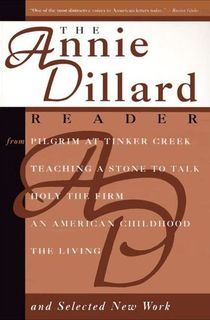
The Annie Dillard Reader
Including chapters from her classic Pilgrim at Tinker Creek and her autobiography, An American Childhood, The Annie Dillard Reader offers a look at “one of the most distinctive voices in American letters today” (Boston Globe).
With some of her best-known stories, novel excerpts, essays, poetry, and more, “this selection of writings, chosen by Dillard herself, provides a perfect sampling of her incisive, versatile, and impeccable achievements” (Booklist).
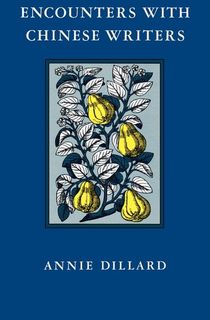
Encounters with Chinese Writers
Winner of the New England Book Award, Encounters with Chinese Writers details author Annie Dillard’s travels to China and her observations of cultural exchanges between Chinese and American writers.
From toasts at a Chinese banquet to an evening among intellectuals, these “keenly observed, often comic encounters” are told with Dillard’s characteristically warm tone (New York Times Books Review).
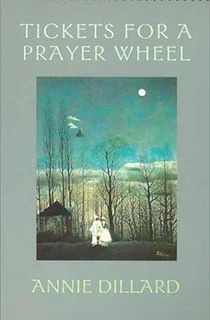
Tickets for a Prayer Wheel
This collection of poems, first gathered in 1974, spotlights many of the themes Annie Dillard will continue to reckon with in her later works.
From science and nature to eternity and time, these poems are filled with vivid imagery, storytelling, and more.
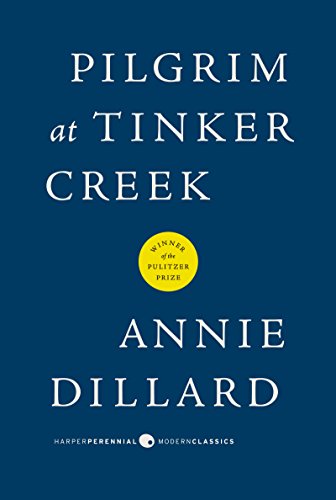
Pilgrim at Tinker Creek
Her most well-known, Pulitzer Prize-winning work, Pilgrim at Tinker Creek, is “a form of meditation, written with headlong urgency, about seeing” (New York Times Book Review).
Over one year, Annie Dillard documents her personal journey, exploring the Virginia region through which Tinker Creek runs.
From the monarch butterfly’s fall migration to following muskrats in the summer, Dillard teaches readers “that we do not live separately from the natural world, but are part of it” (The Guardian).
An American Childhood
In this moving account of her childhood, Annie Dillard chronicles growing up in Pittsburgh, Pennsylvania, during the 1950s and 60s.
Dedicated to her parents, “An American Childhood more than takes the reader’s breath away; rather, “it consumes you as you consume it, so that, when you have put down this book, you’re a different person” (Chicago Tribune).

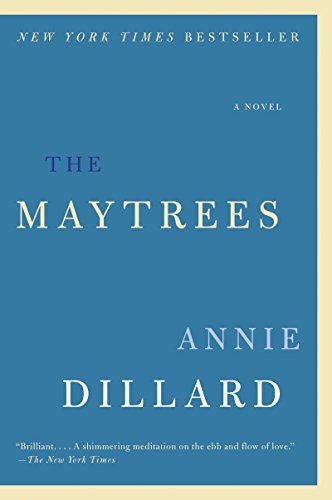
The Maytrees
When Toby Maytree first sees Lou Bigelow riding her bicycle in postwar Provincetown, Massachusetts, she catches him off guard. An educated poet, Toby immediately begins courting Lou, just out of college.
What follows is “an intelligent, exquisite novel”: falling in love, living among nonconformist artists, having their son Petie—and their friend Deary, who changes everything (Washington Post).
Featured image: Jill Krementz


