
 About
About Deals
Deals Articles
 Genres

Researching subjects ranging from global health inequality to the homelessness crisis, Tracy Kidder had a knack for identifying unlikely, underreported subjects and spinning profound narratives. Over and over again across his books, he brought the everyday into vivid detail—and in the process created many a bestseller.
Earlier this month, he sadly died of lung cancer, as reported by his daughter Alice Kidder Bukhman and his son, Nat Kidder. A statement released by his publisher, Penguin Random House, wrote that, “Tracy’s gifts for storytelling and tireless reporting are an enduring reflection of the [...] integrity and endless curiosity he brought to everything he did.”
Kidder’s breakout book, The Soul of a New Machine, was published in 1981 and follows a group of computer engineers as they design a new machine. In 1982, the non-fiction account won the Pulitzer Prize for General Nonfiction and the National Book Award—solidifying him as a master of narrative non-fiction.
After the success, he published House, which captures the journey of a family constructing their home in Massachusetts. He then wrote Among Schoolchildren, offering a glimpse into a year spent in a fifth-grade classroom and its dedicated teacher. Lastly, he explored the dynamics of friendship in Old Friends, which delves into the lives of two elderly roommates.
Born in New York City in 1945, he attended Harvard University. After graduating, he was sent to Vietnam, where he manned a radio research detachment and listed into enemy communications. He documented his experiences in his 2005 memoir, My Detachment, offering an honest, often humorous, account of coming of age in a war.
Kidder went on to enroll in the University of Iowa’s iconic creative writing program, which launched the careers of writers such as Truman Capote and Flannery O'Connor. During his time there, he focused on developing his storytelling skills, setting aside arbitrary genre labels to pursue his goal of becoming a writer who prioritizes empathy above all else.
Throughout his career, he wrote 12 books, each showcasing his characteristic immersive technique and illustrating that there is much to discover in the mundane—one must only pay attention.
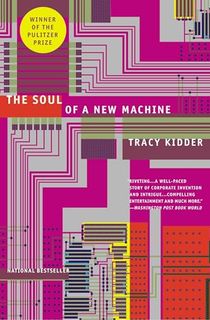
The Soul of A New Machine
In the late 1970s, Tracy Kidder followed a group of engineers at Data General for over a year as they designed and built a new 32-bit minicomputer. In The Soul of a New Machine, he documents how long-time engineers hired recent college graduates, encouraging them to work harder and faster, ultimately exploiting their ignorance.
Through this “total commitment” philosophy, a new work ethic was bred, one in which marathon 24-hour sessions became the norm. Winner of the Pulitzer Prize and the National Book Award, Kidder delivers “a surprisingly gripping account of people at work,” observing the transformation of the high-tech industry into what we recognize today (Wall Street Journal).

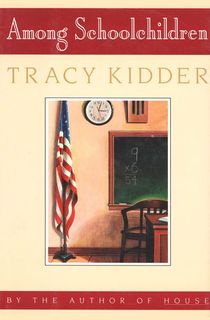
Among Schoolchildren
Across nine months, Kidder immersed himself in Mrs. Zajac’s classroom in Holyoke, Massachusetts. At only thirty-four, she identifies as an “old-lady teacher,” and even though she’s strict, the students adore her.
Across the school year, Mrs. Zajac and her twenty schoolchildren experience numerous joys and tragedies. As put by the New York Times, this is “more than a book about needy children and a valiant teacher; it is full of the author’s genuine love, delight and celebration of the human condition.”

Old Friends
Ninety-year-old Lou didn’t make it through school beyond the eighth grade, worked for the remainder of his life, and loved the same woman for over sixty years. Seventy-two-year-old Joe worked as the chief probation officer in Pittfield, Massachusetts, following the death of his son while raising a mentally challenged daughter.
Now, the two men are living together in a nursing home, and despite coming from very different backgrounds, they are close friends. Journalist Tracy Kidder examines the reality of aging and the struggle of coming to terms with morality.
Old Friends is full of “rich detail and true-to-the-ear dialogue [that] let the brave and determined elderly speak for themselves—and for the continually surprising potential of the human spirit” (Kirkus Reviews).
Featured image: Wikimedia Commons


